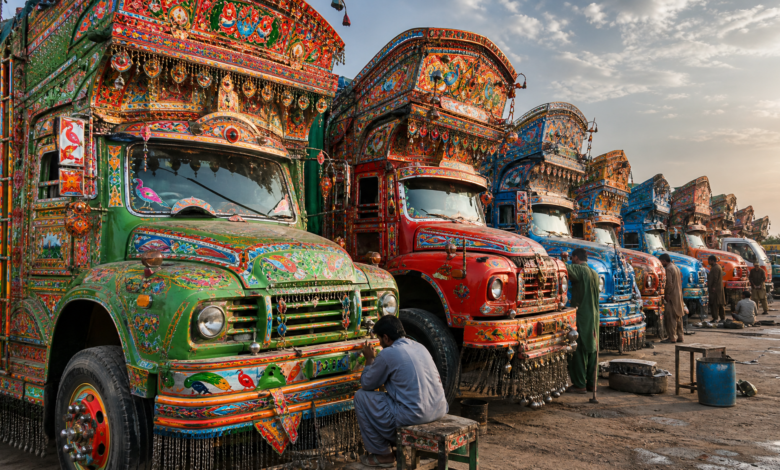
Pakistani truck art is one of the most vibrant and distinctive folk art traditions in the world. What started as a simple practice of decorating transport vehicles has evolved into a celebrated cultural phenomenon that showcases the creativity, spirituality, and artistic heritage of Pakistan.
The Origins of Truck Art
The tradition dates back to the 1920s when the British Raj introduced trucks to the subcontinent. Initially, drivers painted their vehicles to distinguish them from others. Over time, this practical need transformed into an elaborate artistic expression. By the 1950s and 60s, truck art had developed its unique identity, incorporating elements from Islamic art, Persian miniature painting, and local folk traditions.
The Art of Decoration
A fully decorated truck can take months to complete and cost thousands of dollars — often more than the truck itself. The process involves multiple specialized artisans:
The Bodywork Artist creates the base design, painting elaborate floral patterns, landscapes, and geometric shapes on the truck’s exterior. Bright colors like red, orange, green, and yellow dominate the palette, reflecting the region’s love for vivid hues.
The Metalworker adds intricate stainless steel and aluminum cutouts, decorative chains, and mirror work that catch the sunlight as the truck moves along highways.
The Woodworker carves elaborate wooden panels for the cabin interior, often featuring detailed scenes from nature or traditional motifs.
The Calligrapher adds poetic verses, religious phrases, or the driver’s family names in beautiful Urdu or Arabic script.
The Poetry and Slogans: Soul of the Truck
Perhaps the most beloved aspect of Pakistani truck art is the witty, poetic, and often hilarious slogans painted on the back of every truck. These phrases are the voice of the common man — humorous, philosophical, romantic, and sometimes cheeky. They reflect the driver’s personality, his life philosophy, or simply his sense of humor.
Here are some classic examples that have become part of Pakistani pop culture:
1. “فاصلہ رکھیں ورنہ پیار ہو جائے گا”
“Fasla rakhein warna pyar ho jayega”
“Keep Your Distance, Or You Might Fall in Love”
— The ultimate flirtatious warning to the vehicle behind. Playful, confident, and quintessentially Pakistani.
2. “دیکھ مگر پیار سے”
“Dekh magar pyar se”
“Look, But With Love”
— Perhaps the most famous truck slogan of all time. It’s been printed on t-shirts, mugs, and posters worldwide.
3. “ہارن نہ مارو، ڈرائیور سو رہا ہے”
“Horn na maro, driver so raha hai”
“Don’t Honk, The Driver Is Sleeping”
— A humorous excuse for driving slowly. The irony is intentional and the humor is pure.
4. “ماں کی دعا، جنت کی ہوا”
“Maa ki dua, jannat ki hawa”
“A Mother’s Prayer Is Like The Breeze of Heaven”
— A touching tribute to mothers, reflecting the deep respect for family in Pakistani culture.
5. “پاس کر یا برداشت کر”
“Pass kar ya bardasht kar”
“Either Pass Me Or Tolerate Me”
— The confident declaration of a slow driver who knows he’s holding up traffic but isn’t budging.
6. “زid نہ کر رانا، آپ بڑا ضدی ہے”
“Zid na kar RANA, aap bara ziddi ay”
“Don’t Be Obstinate, The Driver Is Also A Nut”
— A playful warning that the driver can be just as stubborn as the person behind him.
7. “جِنّے ماں نوں ستایا، اونّے رکشہ چلایا”
“Jinnay maa nu staya, onny raksha chalaya”
“The One Who Was Rude To Mother, Ends Up Driving A Rickshaw”
— A moral lesson wrapped in humor. Respect your parents, or this is your fate!
Symbolism and Meaning
Every element of truck art carries meaning. The peacock, a recurring motif, symbolizes beauty and pride. Roses and jasmine represent love and fragrance. Eyes painted on the front ward off the evil eye and protect the driver on long journeys.
Drivers often personalize their trucks with portraits of loved ones, favorite singers, or film stars. The back panel typically features a poetic verse or a prayer for safe travel, reflecting the spiritual nature of Pakistani culture.
From Highways to Global Recognition
What began on dusty Pakistani roads has now captured international attention. Truck art has been exhibited in museums from London to New York. Fashion designers have incorporated truck art patterns into clothing and accessories. Major brands like Pepsi, Google, and Samsung have used truck art motifs in their South Asian marketing campaigns.
In 2020, the Islamabad Metropolitan Corporation launched a project to paint public buses in truck art style, bringing this folk tradition into urban public transport. The Sindh government has also worked to preserve truck art by supporting artisan communities in Karachi and Hyderabad.
The Artisan Communities
The heart of truck art lies in its artisan communities. Rawalpindi and Peshawar are famous for their metalwork and mirror embellishments. Karachi and Hyderabad in Sindh produce some of the most elaborate painted designs. Swat and northern regions contribute woodcarving traditions.
These artisans pass their skills down through generations. A young apprentice might spend years learning color mixing before being allowed to paint independently. This apprenticeship system preserves both technique and cultural knowledge.
Modern Adaptations
Contemporary artists are reimagining truck art for new contexts. Haider Ali, one of Pakistan’s most famous truck artists, has painted murals internationally and collaborated with global brands. His work demonstrates how traditional craft can remain relevant in modern design.
Digital artists now create truck art-inspired graphics for social media, websites, and mobile applications. The bold colors and intricate patterns translate beautifully to digital formats, introducing this tradition to younger generations.
Conclusion
Pakistani truck art represents the soul of a nation that finds beauty in everyday objects and transforms the mundane into the magnificent. It reflects a culture that values ornamentation, celebrates color, and believes that even a working truck deserves to be a masterpiece.
The next time you see a brightly decorated truck on a Pakistani highway, read the slogan on the back. You might find wisdom, humor, or a flirtatious wink from the driver. You’re not just looking at a vehicle — you’re witnessing a moving museum of folk art, a testament to human creativity, and a tradition that has turned the ordinary into the extraordinary for nearly a century.
What’s your favorite truck slogan? Have you seen one that made you laugh or think? Share in the comments below!