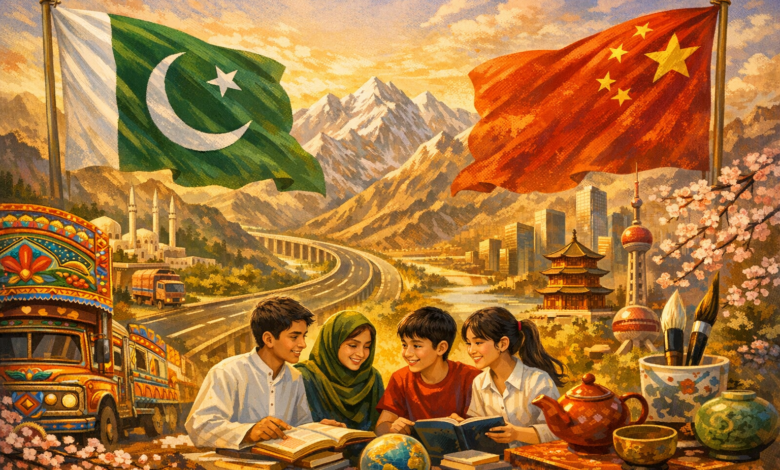
In 1951, Pakistan made a bold diplomatic decision that would reshape its foreign policy for generations. By becoming one of the first Muslim-majority nations to recognize the newly formed People’s Republic of China, Pakistan laid the foundation for what would become one of the world’s most enduring strategic partnerships. Seventy-five years later, that friendship — often described by both nations as “higher than mountains, deeper than oceans, sweeter than honey” — continues to evolve, with cultural exchange now taking center stage alongside economic cooperation.
The Platinum Jubilee: A Year of Celebration
The year 2026 marks the 75th anniversary of Pakistan-China diplomatic relations, and both governments have committed to making it a landmark celebration. The festivities officially kicked off on January 4, 2026, when Pakistan’s Deputy Prime Minister and Foreign Minister Ishaq Dar visited Beijing for the 7th Pakistan-China Foreign Ministers’ Strategic Dialogue. During this historic visit, both nations unveiled the official anniversary logo and launched a special photo exhibition chronicling seven decades of friendship.
Chinese Ambassador Jiang Zaidong outlined an ambitious agenda for the celebrations, emphasizing enhanced cooperation in education, culture, youth exchanges, and even space exploration — with preparations underway for the first Pakistani astronaut to visit the Chinese space station. This isn’t merely diplomatic theater; it represents a deliberate strategy to deepen people-to-people connections that will sustain the relationship for decades to come.
Beyond Infrastructure: The Cultural Dimension of CPEC 2.0
While the China-Pakistan Economic Corridor (CPEC) has delivered remarkable infrastructure achievements — 8,000+ megawatts of electricity, the 1,300-kilometer Karakoram Highway, and billions in investment — the next phase promises something equally transformative. CPEC 2.0 places unprecedented emphasis on what officials call “small yet beautiful” livelihood projects: technical and vocational training for Pakistani youth, agricultural modernization, healthcare improvements, and — most significantly — expanded cultural and educational exchanges.
The corridor is no longer just about roads and power plants. It’s about building bridges between societies.
Education: The New Silk Road
Perhaps nowhere is the cultural exchange more visible than in education. Today, approximately 32,000 Pakistani students are pursuing higher education in Chinese universities — one of the largest foreign student populations in China. Meanwhile, five Confucius Institutes operate across Pakistan, with over 700 students enrolled in Chinese language programs. The demand is so strong that in 2025, a new Chinese language platform was introduced across 20 universities in Sindh Province alone.
This educational exchange isn’t one-directional. Pakistani scholars and researchers regularly collaborate with Chinese counterparts on projects ranging from archaeology to cutting-edge technology. The HEC Cultural Exchange Scholarships Program 2026 offers fully funded Master’s and PhD opportunities, ensuring this trend accelerates further.
Youth, Media, and the Digital Frontier
The Joint Statement from the 7th Strategic Dialogue explicitly committed both nations to enhance exchanges in youth engagement, tourism, radio and television, online audio-visual services, and think tank collaboration. In an era where digital connectivity transcends geography, Pakistan and China are leveraging technology to foster genuine cultural understanding.
Chinese media cooperation will support the “dissemination of Chinese cultures” through Pakistan’s national fiber-optic backbone — a project that serves both practical infrastructure needs and cultural diplomacy goals. Meanwhile, Urdu learning centers in China and Chinese language programs in Pakistan continue to multiply, creating linguistic bridges between peoples.
Looking Forward: An All-Weather Partnership for a New Era
As both nations prepare to celebrate 75 years of diplomatic ties on May 21, 2026, the relationship stands at an inflection point. The “iron brothers” are transforming a historically political-military partnership into a comprehensive societal connection. From the Gwadar Port to university classrooms, from space stations to cultural festivals, the breadth of cooperation reflects a shared vision for regional stability and mutual prosperity.
The anniversary celebrations throughout 2026 will include art exhibitions, music festivals, literary exchanges, and business conferences — but the most meaningful impact will likely be felt in the quiet exchanges: a Pakistani student learning Mandarin in Wuhan, a Chinese engineer sharing tea with colleagues in Islamabad, a joint research paper published by scholars in both nations.
These are the threads that weave true cultural relations. And after 75 years, that fabric is only growing stronger.
About AINI: AINI.pk covers the intersection of artificial intelligence, international relations, and cultural diplomacy across South Asia and beyond.