Pakistan-China Cultural Relations: The Human Bridge Behind 75 Years of Friendship

By AINI Editorial Desk | May 21, 2026
Pakistan and China are often described through the language of strategy: CPEC, trade routes, security cooperation and diplomatic alignment. Yet the most durable part of the relationship may be less visible on maps and balance sheets. It lives in classrooms, cultural centres, language programmes, youth exchanges, films, books, festivals and the everyday curiosity that allows two ancient civilisations to understand one another beyond official statements.
That people-to-people dimension has moved into sharper focus in 2026 as both countries mark the 75th anniversary of diplomatic relations. During the seventh round of the China-Pakistan Foreign Ministers’ Strategic Dialogue in Beijing, the two sides announced a year-long series of commemorative activities designed not only to celebrate history but also to deepen cultural and educational cooperation for the next generation. The same communiqué highlighted youth, education, culture, tourism, media, think tanks and sub-national exchanges as key areas for future engagement.
This matters because Pakistan-China friendship has reached a stage where infrastructure alone cannot carry the story. Roads, ports and energy projects create connectivity, but culture creates confidence. When Pakistani students study Mandarin at Confucius Institutes, when Chinese universities host Pakistan Study Centres, when artists and performers share stages in Islamabad, Lahore, Beijing or Shenzhen, the relationship becomes more human and more resilient. It is no longer only a government-to-government partnership; it becomes a society-to-society conversation.
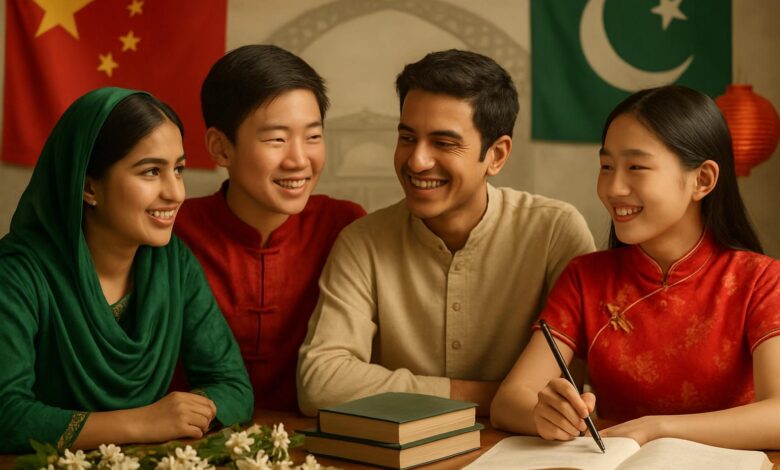
Recent cultural events show how this shift is already taking place. A children’s gala in Islamabad celebrating the anniversary brought together students, teachers, officials and members of the Chinese community. Pakistani children performed in green and white, Chinese children appeared in traditional attire, and both sides used music, dance and storytelling to make diplomacy understandable to young minds. Such events may appear ceremonial, but they perform an important function: they teach children that international friendship is not abstract. It can be seen, heard, sung and shared.
Education is another powerful bridge. As CPEC enters its upgraded “2.0” phase, the emphasis is widening from roads and energy toward industry, agriculture, technology, vocational training and knowledge exchange. This creates new demand for bilingual professionals, researchers, technicians and entrepreneurs who can operate comfortably in both Pakistani and Chinese contexts. Cultural literacy will therefore become an economic asset. A Pakistani engineer who understands Chinese work culture, or a Chinese investor who understands Pakistan’s languages, local customs and social dynamics, will be better positioned to build trust and avoid misunderstandings.
Tourism also holds untapped promise. The year-round opening of the Khunjerab Pass, mentioned by both governments as an opportunity for trade and people-to-people exchange, can help transform the northern corridor into a cultural route as well as a commercial one. From the mountains of Gilgit-Baltistan to the heritage cities of Punjab and Sindh, Pakistan has much to offer Chinese visitors. Likewise, Pakistani travellers increasingly see China not only as a business destination but as a civilisation with deep historical, artistic and technological richness.
Media and digital platforms will play a crucial role in shaping this next chapter. For decades, the phrase “iron brotherhood” has captured the strength of Pakistan-China ties. The challenge now is to give that phrase fresh meaning for younger audiences who consume news through short videos, podcasts, online courses and social media. Joint documentaries, student vlogs, cultural exchange series and translated literature can help both societies move beyond stereotypes and build a more textured understanding of one another.
There is also room for honesty. Cultural relations become stronger when they are not reduced to slogans. Pakistan and China have different languages, histories, political systems, food cultures and social habits. Productive friendship does not require pretending those differences do not exist. It requires creating enough contact, respect and institutional support so that differences become sources of learning rather than distance.
As the 75th anniversary activities continue through 2026, the opportunity is clear: Pakistan and China can turn cultural cooperation into a central pillar of their shared future. The next phase of the relationship should be measured not only by kilometres of road or megawatts of power, but by the number of students exchanged, books translated, artists hosted, tourists welcomed, research partnerships formed and friendships made across borders.
In that sense, the cultural bridge between Pakistan and China is not decorative. It is strategic. It is the human foundation on which every other form of cooperation depends.