Pakistan and China are marking 75 years of diplomatic relations at a moment when their partnership is being described not only through the familiar language of strategy and economics, but also through the quieter, more lasting language of culture, education and people-to-people trust.
The anniversary has brought a visible wave of commemorations in both countries. In Islamabad, national leaders reaffirmed that the relationship remains a cornerstone of Pakistan’s foreign policy, while President Asif Ali Zardari unveiled a commemorative postage stamp to mark the milestone. Pakistan is also issuing a special PKR 75 commemorative coin, giving the anniversary a public symbol that ordinary citizens can hold, collect and remember. These gestures may appear ceremonial, but they matter: cultural memory is often built through symbols, stamps, coins, exhibitions, student exchanges and shared stories.
In Beijing, Prime Minister Shehbaz Sharif’s recent meeting with President Xi Jinping again placed the phrase “iron brothers” at the centre of the relationship. President Xi described Pakistan-China friendship as “unbreakable,” while both sides spoke of deepening their all-weather strategic cooperative partnership. Yet beneath the diplomatic vocabulary lies a broader reality: the bond between Pakistan and China has increasingly moved beyond government offices into classrooms, cultural centres, universities, media platforms, language institutes and professional networks.
This people-centred dimension is becoming one of the most important features of the next phase of Pakistan-China relations. Thousands of Pakistani students now study in Chinese universities, particularly in fields such as medicine, engineering, artificial intelligence, agriculture and information technology. Many return with not only degrees, but also firsthand familiarity with Chinese society, language, work culture and innovation systems. At the same time, Chinese professionals working in Pakistan through CPEC-related projects interact daily with Pakistani engineers, entrepreneurs, teachers and local communities. These everyday exchanges build practical understanding in a way that official statements alone cannot.
The China-Pakistan Economic Corridor has often been discussed in terms of roads, energy projects, ports and industrial zones. But CPEC also has a cultural story. The Karakoram Highway, frequently called the China-Pakistan Friendship Highway, is more than a transport route; it is a modern continuation of the region’s old Silk Road imagination. It connects landscapes, languages, cuisines and communities. As CPEC enters its next phase, with emphasis on agriculture, technology, special economic zones, minerals, green development and youth skills, cultural familiarity will become even more important. Development projects succeed best when people understand one another’s values, expectations and working styles.
Pakistan and China also share a history of supporting each other during difficult times. Pakistani leaders have recalled China’s assistance during floods, earthquakes and economic challenges, while Pakistan has consistently supported China on core diplomatic issues. This record of mutual support has shaped public sentiment in both countries. In Pakistan, China is widely viewed as a reliable friend; in China, Pakistan is often presented as a trusted partner with a relationship built on respect rather than temporary convenience.
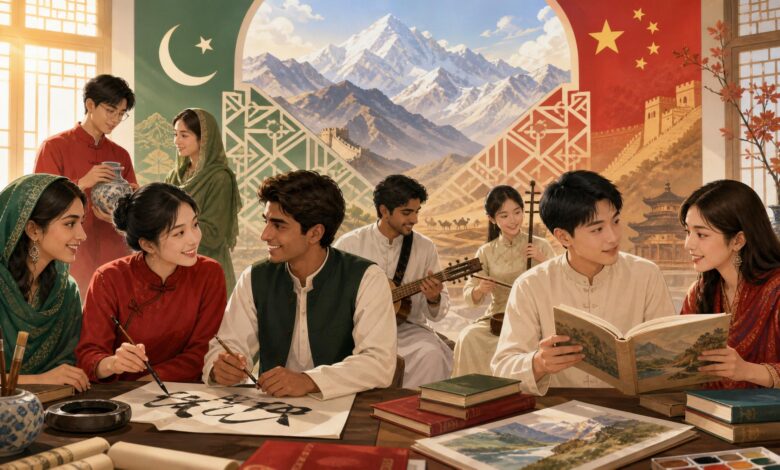
The opportunity now is to make cultural cooperation broader, younger and more creative. More joint film projects, tourism exchanges, translation programmes, digital media collaborations, sister-city partnerships and youth innovation forums could help the next generation see the relationship as something alive and personal. Cultural diplomacy should not be limited to formal ceremonies. It should include food festivals, university debates, art residencies, documentary production, language learning, sports exchanges and technology bootcamps where young Pakistanis and Chinese can work together.
As the two countries celebrate 75 years of diplomatic relations, the strongest message is not simply that Pakistan and China have a long friendship. It is that this friendship is changing shape. It is becoming more educational, more digital, more youth-driven and more culturally visible. Strategic cooperation may provide the framework, but cultural understanding gives the relationship its staying power.
For Pakistan, this is a chance to engage China not only as an economic partner, but as a civilisational neighbour with whom it can share ideas, creativity and human talent. For China, Pakistan offers a young, dynamic society with deep traditions, regional importance and a population eager for opportunity. The next 75 years of Pakistan-China relations will be shaped not only by leaders and infrastructure, but by students, artists, entrepreneurs, teachers and communities who turn diplomatic friendship into lived experience.
Sources referenced include recent reporting from CGTN, The Nation, Al Jazeera, People’s Daily and The Hindu on the 75th anniversary of Pakistan-China diplomatic relations, commemorative events, leadership meetings and expanding people-to-people cooperation.