May 10, 2026
In 2026, Pakistan and China mark a momentous milestone — the 75th anniversary of their diplomatic relations. What began on May 21, 1951, has evolved into one of the world’s most enduring and multifaceted partnerships, often described by leaders from both nations as an “all-weather strategic cooperative partnership” and, more affectionately, as a friendship “higher than the mountains, deeper than the oceans.”
While much attention is rightfully given to the China-Pakistan Economic Corridor (CPEC) and defense cooperation, the cultural dimension of this relationship deserves equal celebration. It is through art, education, people-to-people exchanges, and shared traditions that the true depth of Pakistan-China ties becomes visible.
A Cultural Renaissance in the 75th Year
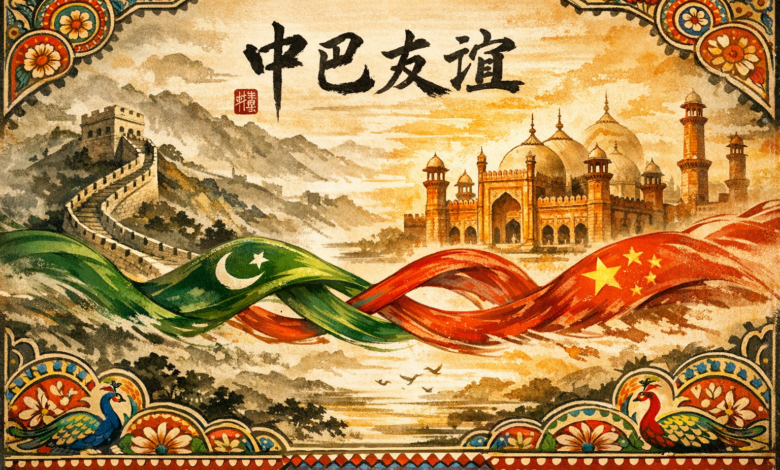
This year has witnessed an extraordinary surge in cultural diplomacy between the two nations. In March 2026, the Pakistan National Council of Arts in Islamabad hosted a landmark China-Pakistan Art Exhibition, bringing together prominent artists from both countries. The exhibition featured works that blended traditional Chinese ink brush painting with vibrant Pakistani truck art motifs — a visual metaphor for the synthesis of two rich civilizations.
Minister of State for Federal Education and Professional Training Wajiha Qamar, addressing the exhibition’s opening ceremony, emphasized that “Pakistan-China relations go beyond strategic and diplomatic engagement, reflecting strong cultural and people-to-people connections.” Her words captured the essence of what makes this bilateral relationship unique: it is not merely transactional but deeply rooted in mutual respect and affection.
Chen Peng, Cultural Counselor at the Chinese Embassy in Pakistan, described the exhibition as “a reflection of mutual trust, cultural harmony and sustained cooperation.” Such cultural initiatives, he noted, play a vital role in promoting mutual understanding and bringing the two peoples closer.
From Canvas to Infrastructure: CPEC as Cultural Bridge
The China-Pakistan Economic Corridor, now entering its second phase (CPEC 2.0), has always been more than a collection of roads, power plants, and ports. It is a physical manifestation of shared aspirations. During a recent ceremony at the UNI International-China Pakistan Deep Love Cultural Exploration Center in Islamabad, former Prime Minister Raja Pervaiz Ashraf recalled historical moments of mutual support and solidarity, urging younger generations to carry forward this legacy of trust.
Landmark projects completed over the past two decades — from the PKM Motorway and Islamabad International Airport to the iconic Centaurus complex — have transformed Pakistan’s infrastructure landscape. But beyond concrete and steel, these projects have created spaces where Pakistani and Chinese professionals work side by side, exchanging ideas, languages, and traditions.
Education and Youth: The Future of the Friendship
One of the most significant cultural developments in recent years has been the explosion of educational exchanges. Thousands of Pakistani students now study in Chinese universities, particularly in fields like medicine, engineering, and information technology. Chinese language programs have proliferated across Pakistan, with Confucius Institutes and cultural centers operating in major cities.
These educational exchanges are creating a generation of “cultural ambassadors” — young Pakistanis who speak Mandarin and young Chinese who understand Urdu poetry and Pakistani hospitality. As student Hamza Ali of the National College of Arts remarked during the art exhibition: “Such exhibitions help young people better understand other cultures.”
Looking Ahead: CPEC 2.0 and Cultural Cooperation
President Asif Ali Zardari’s recent visit to China marked a strategic shift toward CPEC 2.0 — a phase emphasizing technology, agriculture, and private-sector collaboration. This evolution presents new opportunities for cultural and academic cooperation. Joint research initiatives, digital cultural archives, collaborative filmmaking, and tourism partnerships are natural extensions of this upgraded partnership.
The mining and minerals sector, highlighted during recent bilateral forums, also carries cultural significance. Pakistan’s rich geological heritage and China’s expertise in sustainable extraction can be framed within a shared commitment to preserving natural and cultural landscapes for future generations.
Conclusion
As Pakistan and China celebrate 75 years of diplomatic relations in 2026, the cultural thread running through their partnership remains as vibrant as ever. From art exhibitions that blend Chinese calligraphy with Pakistani miniature painting, to educational exchanges that build lifelong friendships, to infrastructure projects that physically connect the two nations — the Pakistan-China relationship is a model of how countries can cooperate not just for strategic advantage, but for genuine mutual enrichment.
In a world too often divided by misunderstanding and suspicion, the Pakistan-China friendship stands as a testament to what is possible when two civilizations choose to learn from each other, respect each other, and grow together. As the youth of both nations increasingly interact through art, education, and digital platforms, this ironclad friendship is poised to enter its next 75 years with even greater cultural depth and vitality.
Written for AINI.pk — Pakistan’s Voice for Cultural Diplomacy and International Relations