Pakistan-China Launch Information Corridor: Cultural Diplomacy Enters the Digital Age

November 18, 2026 — Islamabad
Pakistan and China have taken a decisive step into the future of cultural diplomacy with the launch of the China-Pakistan Information Corridor (CPIC) — a groundbreaking initiative designed to counter misleading narratives, promote authentic cultural exchange, and deepen people-to-people connections between the two nations. The announcement, made earlier this month by Pakistan’s Information Minister Ataullah Tarar, signals a bold new chapter in the 75-year friendship between the two countries.
What Is CPIC?
The China-Pakistan Information Corridor is more than a media partnership. It represents a comprehensive framework for cooperation between think tanks, media organizations, content creators, and cultural institutions on both sides. According to Minister Tarar, the initiative will focus on three core pillars: countering misleading narratives, promoting cultural exchanges, and fostering collaboration between research institutions.
In an era where information flows shape public perception as powerfully as traditional diplomacy, CPIC aims to ensure that the story of Pakistan-China friendship is told accurately — and told widely. The corridor will facilitate joint content production, journalist exchanges, and the wider distribution of Chinese content in English and Urdu, making cultural material accessible to millions across both nations.
A Cultural Film Festival Lights Up Islamabad
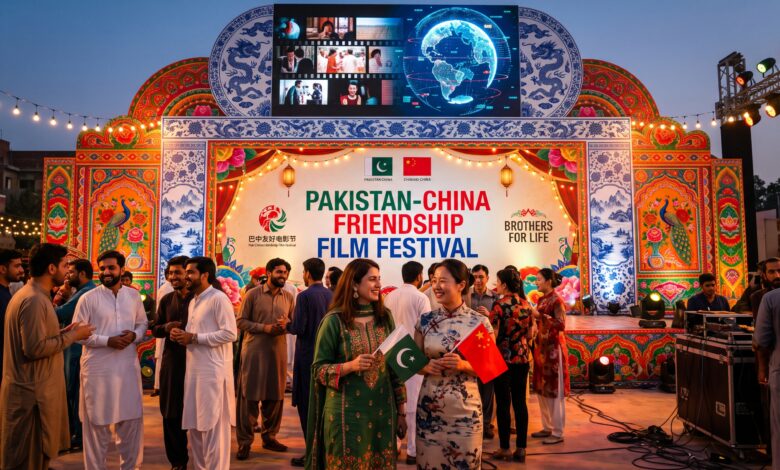
The CPIC launch coincided with another landmark event: the Pakistan-China Cultural Film Festival, held in Islamabad earlier this month. The festival brought together filmmakers, artists, and cultural enthusiasts from both countries, showcasing cinematic works that explore the shared values, histories, and aspirations of the two nations.
Speaking at the festival, Minister Talal Chaudhry reaffirmed that Pakistan-China relations were expanding across multiple sectors — trade, infrastructure, education, technology, and now, increasingly, culture and media. He emphasized that the true strength of this bilateral friendship lies not in agreements and memoranda, but in goodwill and genuine people-to-people connections.
The festival featured screenings of Chinese and Pakistani films, panel discussions on co-production opportunities, and workshops for emerging filmmakers. Events like these demonstrate that cultural diplomacy is no longer a ceremonial afterthought — it is a central pillar of the relationship.
Porcelain and Contemporary Art: A Living Bridge
Just days before the film festival, the National Museum Islamabad hosted a stunning joint exhibition of Chinese porcelain artefacts and contemporary art, organized under the National Heritage and Culture Division in collaboration with the Department of Archaeology and Museums and the China Cultural Center in Pakistan.
The exhibition featured exquisite Tang Sancai horse and camel figurines, delicate Ru porcelain celadon wares, vibrant blue-and-white floral vessels, and intricately sculpted peony plates — each piece telling a story of centuries-old craftsmanship that once traveled the ancient Silk Road. Students from Islamabad Model College for Girls participated in a ceramic painting workshop, engaging directly with Chinese motifs and artistic techniques.
Parliamentary Secretary Farah Naz, addressing the inaugural ceremony, highlighted that such initiatives provide invaluable opportunities to showcase rich cultural heritage and artistic traditions. Chinese Embassy Counsellor Cheng Peng described cultural cooperation as an essential pillar of the broader bilateral relationship — one that complements the economic and strategic dimensions of CPEC.
From Infrastructure to Ideas: The CPEC 2.0 Cultural Dimension
As the China-Pakistan Economic Corridor enters its upgraded “2.0” phase, the emphasis is widening from roads, ports, and energy projects toward industry, agriculture, technology, vocational training, and — crucially — knowledge and cultural exchange. This shift recognizes that lasting partnerships are built not only on trade figures but on mutual understanding, shared stories, and human connections.
Education and academic exchanges continue to expand. More Chinese universities are establishing Pakistan research centers, while Pakistani universities are developing dedicated China studies institutions. Confucius Institutes across Pakistan report growing enrollment in Mandarin courses, reflecting the rising demand for language skills that bridge the two cultures.
The creative industries present enormous untapped potential. Film and television co-productions, literary translation, artist exchanges, animation and gaming collaborations, and youth cultural programs are all areas where deeper cooperation could yield transformative results — creating jobs, building soft power, and fostering a generation of cultural ambassadors.
The Road Ahead
Seventy-five years of diplomatic relations have proven that Pakistan-China friendship is not merely strategic — it is deeply human. From the ancient Silk Road to the modern digital highway, the two nations have continually found new ways to connect, share, and grow together.
The launch of CPIC, alongside film festivals, art exhibitions, and educational exchanges, marks a recognition that the next phase of this friendship must be built on narratives as much as infrastructure. In a world where stories shape realities, Pakistan and China are ensuring that their shared story is told — authentically, collaboratively, and for generations to come.
Sources: The Nation (Nov 13, 2026), DAWN, The Daily CPEC, Xinhua, Global Times, 24NewsHD


